Magneto-Mechanical Resonators
Passive, battery-free and wireless sensors for tracking and sensing
Magneto-mechanical resonators (MMR) are a young sensor concept that we develop at the Chair of Metrology in Rostock. An MMR consists of two permanent magnets: a stator fixed to the housing and a rotor that can turn around its main axis. The magnetic interaction between both magnets creates a restoring torque, so that the rotor performs a damped oscillation after excitation.
Because the resonance frequency depends on the distance between the magnets, a single millimeter- or sub-millimeter-sized component yields the position and full orientation (tracking) as well as a physical quantity (sensing), for example temperature via thermal expansion or pressure via a compressible housing. MMR need neither a power source nor an antenna, work without line of sight and are inexpensive to manufacture.
Our current work concentrates on four directions:
- making the readout devices more sensitive through low-noise signal processing,
- modelling and characterizing the sensors to understand their behaviour and its effect on measurement accuracy,
- solving the inverse problem of orientation and position more precisely,
- developing new excitation approaches for MMR.
Target applications are radiation-free navigation of medical instruments, swallowable and implantable sensors for physiological parameters, and robust measurements in industrial processes such as pressure and temperature in bioreactors.


References
2026
-
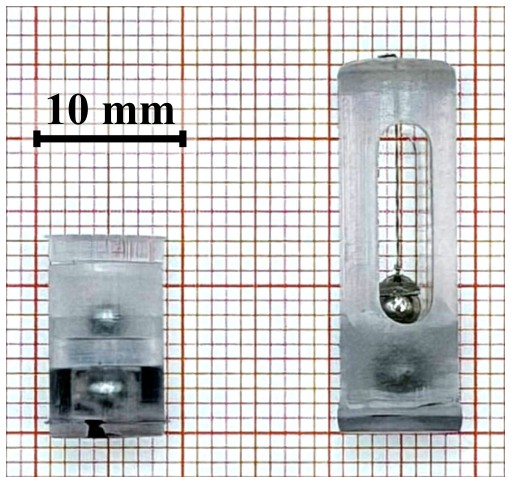 Impact of Structural Design on Magneto-Mechanical Resonators: The Case of a Jewel Bearing VariantarXiv preprint, 2026
